Webinars Hub
Photo credit: The Ocean Agency / Ocean Image Bank
Watch the ECOP webinar recordings
The ECOP Programme facilitates a series of webinars to discuss topics and themes of interest to our community and related to the UN Ocean Decade. Below you can find the recordings of the webinars, click on each one to learn more. To watch the recordings on our YouTube channel, click on the button of your chosen webinar.
ECOP WEBINARS
Working with Underwater Video
Ocean Data Workflows: From Discovery to Collaboration with the Ocean Data Platform (ODP)
Interfacing with the ocean – An ArtWaves Artist Residency project
Africa and the Decade of Ocean Science
UNIDO-WTCA BLUE ECONOMY GLOBAL CALL 2026
Empowering ECOPs in Ocean Sustainability: Perspectives from the Global Estuaries
Careers, Skills, and Opportunities: IMarEST’s Role in the UN Ocean Decade
The Ocean is our Future
Microplastic Transport from Wastewater Treatment Plants - Where do they go?
Ocean Careers: From First Steps to Finding Your Path
Crowdsourced Research with Zooniverse: Unlocking your Data and Engaging the Public
Citizens of Surf webinar: Change in the Lineup
Supporting coastal MPA monitoring with accessible technology
Presentation of the International Platform for Ocean Sustainability IPOS
Sailing for change and the UN Ocean Decade
We are the ocean: The planetary organism
Building a global science community through summer schools in West Africa, East Africa
Engaging science, policy and art in the Ocean Decade
Robotics and Workforce in Marine Science
Demystify the Blue Economy: Trends, Pathways, and Opportunities
Creative Science Communication Workshop II: Turning Your Ideas into Real SciArt Projects
Ocean Decade: Call for Actions and Ocean Connector
Bridging science with societal needs through public products
Making the Invisible Visible: Tracking Biodiversity and Oil Pollution from Space
Insights into Scientific Writing for Early Career Scientists, ECOPs and Students
Spotlight on Action: The practice of protecting and restoring blue carbon ecosystems
Creative Approaches to Science Communication
The Brillant Blue Challenge
Navigating Opportunities: The Sustainable Blue Economy for ECOPS and Youth in Canada
Ocean Adventures for Citizen Scientists
Development opportunities for ECOPs with ASLO
Data Management
Capacity development opportunites for ECOPs with POGO and SCOR
How to engage ECOPs in global knowledge-policy-society interfaces?
Trash to Treasure - Repurposing Marine Debris for a Healthier Ocean
Shaping the future of Ocean Prediction
Towards Sustainable Small-Scale Fisheries
Unlocking Ocean Insights: Innovative Low-Cost Technologies for Marine Ecosystem Study
Programa de la Red Early Career Ocean Professionals (ECOP)
Conservation and Restoration of Seagrass webinar
Experiencia Erasmus Mundus – MER + & Global Ocean Carbon Uptake
The use of drones in marine sciences
Stoked about Ocean Science with Citizens of Surf
Ocean literacy in India
Plastics in the Pacific and on Hawaii with STORAGE
Emerging ocean technologies supporting polar science for the next decade
Funding opportunities, tips and challenges with Challenger Society for Marine Sciences
Underwater acoustics with Suleman Mazhar
Using ArcGIS software for Oceans-related work: An Overview
Was 2022 truly the Ocean Super Year we hoped for?
Understanding the UN Ocean Decade - What's in it for African ECOPs?
The Blue Economy
How to start an NGO?
Episode 53: Working with Underwater Video
SeaTube is an easy-to-use video annotation system utilizing either archived or real-time/live streaming video. It provides support for unlimited, geographically separated groups of users who can simultaneously apply annotations to the video stream. The resulting archive is fully searchable, allowing users to easily locate and bookmark and download video clips of interest, static images, annotations, and related sensor data. In this session, you will get an overview of SeaTube and learn how to use some exciting newly released capabilities for working with fixed-location camera recordings.
Episode 52: Ocean Data Workflows: From Discovery to Collaboration with the Ocean Data Platform (ODP)
Discover how modern ocean data workflows can take you from accessing datasets to exploring, analysing, and sharing your own work. This session includes a live walkthrough and practical examples, showing how a free-to-use platform can support collaboration and help you apply these approaches in your own work—using the Ocean Data Platform (ODP) developed by HUB Ocean.
Episode 51: Interfacing with the ocean – An ArtWaves Artist Residency project
ArtWaves is an Artist Residency program at the Helmholtz-Institute for Functional Marine Biodiversity and the Hanse Wissenschaftskolleg, Institute of Advanced Study. Being officially endorsed as an UN Ocean Decades Action the residency tries to bring together artists and researchers and create a space to think differently and address aspects of marine biodiversity change and public understanding about the complexity of our oceans differently. In this Webinar the program will be introduced shortly and Max Seeger, the last Artist in Residence, will show some of his work and give insights into the time of his residency.
Episode 50: Africa and the Decade of Ocean Science
Tentative – Africa & the Ocean Decade – Africa is a major ocean continent with growing but uneven science capacity, and the Ocean Decade offers a platform to close long-standing equity gaps. How do we shift from fragmented projects to regional systems that deliver decision-ready science for policy? Can the decade catalyze Africa-led and stronger science–policy–society connections?
Episode 49: UNIDO-WTCA BLUE ECONOMY GLOBAL CALL 2026
This webinar will present details (including scope, timeliness, eligibility, and rewards) and answer potential applicants’ questions on the Call. Launched by the United Nations Industrial Development Organization (UNIDO) through its Italian Investment and Technology Promotion Office (ITPO Italy) and the World Trade Centers Association (WTCA), the Global Call aims to identify and accelerate the most innovative solutions shaping the future of the Blue Economy. The selected winning solutions—one per thematic area—will be officially awarded at the Euro-Mediterranean Water Forum, to be held in Rome from 29 September to 2 October 2026, and will gain access to a dedicated acceleration program offering technical support, international visibility, as well as business and investment opportunities. Note: Applications will close on 19 June 2026
Episode 48: Empowering ECOPs in Ocean Sustainability: Perspectives from the Global Estuaries
The Global Estuaries Monitoring (GEM) Programme regularly hosts webinars approximately every two to three months. We are planning a special webinar for ECOPs in May 2026, which will also mark the third GEM Webinar. It would be beneficial if our GEM and ECOP Programmes could collaborate on this joint webinar. We can contribute one talk, and we also invited Dr. Shenghui Li from the ECOP Programme to contribute one talk. Our GEM Webinars cover a broad range of topics related to UN SDGs 14 and 17.
Episode 47: Careers, Skills, and Opportunities: IMarEST’s Role in the UN Ocean Decade
This webinar will explore careers, skills, and professional opportunities within the UN Ocean Decade, with a focus on IMarEST’s role as a Decade Implementing Partner. It will highlight key initiatives that support capacity development, knowledge sharing, and early career progression, including mentoring, training, and recognition schemes. Attendees will gain insight into practical pathways, resources, and networks available to support careers in marine science and the blue economy.
Episode 46: The Ocean is our Future
The German Ocean Foundation is committed to preserving the health of our ocean and protecting it as a vital ecosystem. As a UN Decade Implementing Partner, this webinar will present and reflect upon the Foundation’s projects, which combine research, education, and social engagement. Our aim is to communicate knowledge about the ocean in an accessible way, to highlight its diversity, and to empower people of all generations to actively contribute to marine conservation. The presentation will demonstrate how to foster dialogue between science, business, politics, and the public to develop sustainable solutions. We want to inspire visitors to take responsibility for our planet’s largest ecosystem and to take steps together towards a future worth living..
Episode 45: Microplastic Transport from Wastewater Treatment Plants – Where do they go?
Microplastics are widespread in aquatic ecosystems, with wastewater treatment plants being a consistent source of dispersal. This seminar aims to follow their journey from manufacture to post-treatment discharge, and uses applied research from hydrodynamic and particle-tracking computer modelling studies. Tracking the transport and fate of these plastics is critical for understanding impacts across human, organismal, and environmental systems.
Episode 44: Ocean Careers: From First Steps to Finding Your Path
Navigating a career in the ocean sector can feel complex, non-linear, and at times overwhelming – especially in the early stages. This webinar brings together diverse perspectives to explore how different paths into ocean-related careers evolve, and how to approach key challenges along the way.
Episode 43: Crowdsourced Research with Zooniverse: Unlocking your Data and Engaging the Public
🌊 ECOP Webinar #43: Crowdsourcing Research with Zooniverse
Join Dr. Laura Trouille (Adler Planetarium) as she introduces Zooniverse, a platform where millions of volunteers help researchers analyze data faster.
🔍 In this webinar: How to crowdsource scientific research Using citizen science + AI Real examples from ocean and environmental studies How to build your own project
Episode 42: Citizens of Surf webinar: Change in the Lineup
This webinar brought together a global community of surfers, scientists and ocean advocates to explore how surf culture and ocean research are increasingly interconnected. “Change in the Lineup” focused on the powerful role surfers can play in understanding and protecting our ocean, highlighting how lived coastal experience, local knowledge and scientific research can work together to drive meaningful change.
🎯 Key themes from the session included:
• Rethinking ocean governance by valuing community-led knowledge and stewardship (Kizzy Beaumont @ 3min)
• How surfers are contributing to ocean data collection through citizen science (Jessica Bradford @ 17min)
• New technologies improving how we measure and understand waves in dynamic surf zones (Matheus Vieira @ 28min)
• The importance of embodied experience and identity in shaping ocean connection (Anna Rickmann @ 43min)
• Advancing equity, diversity, and inclusion in surf and ocean conservation spaces (Yvette Cave @ 56min)
• Community-driven approaches to coral reef monitoring and climate resilience (Kailey Pascoe @ 1h16min)
Across the talks, one message stood out: surfers are not just ocean users; they are observers, storytellers, data collectors and changemakers.
💬 The session closed with a discussion on how we can collectively create safer, healthier and more inclusive lineups, and how individuals can get involved in ocean action moving forward.
🌍 Hosted by Citizens of Surf as part of the UN Ocean Decade ECOP Programme, this webinar highlighted the growing momentum behind community-driven ocean science and regenerative approaches to coastal futures.
Episode 41: Supporting coastal MPA monitoring with accessible technology
🌍Join us for ECOP Program Webinar Series Episode 41 to discover how innovative observing systems are advancing marine conservation! This webinar features the ProtectedSeas Marine Monitor (M2)—an endorsed UN Ocean Decade Contribution—demonstrating how established technologies such as radar and camera systems can support effective monitoring of coastal Marine Protected Areas (MPAs).
🔍 Learn how these integrated tools provide actionable insights on human activity near MPAs, supporting evidence-based management and local conservation strategies.
🌊 Hear directly from M2 users: Anastasia Kunz Cervantes, Lillie M., Samantha King, and Bryant I. as they share real-world applications and experiences, offering practical perspectives to inform and inspire future ocean monitoring efforts.
Episode 40: Presentation of the International Platform for Ocean Sustainability IPOS
🌍 Join us for Episode 40 of our ECOP Programme Webinar Series – where we introduce the IPOS (International Platform for Ocean Sustainability) and explore how ECOPs can actively contribute to advancing global ocean sustainability efforts. Speakers:
- Lucas BECQUET (IPOS project manager for the ocean sustainability foundation)
- Pablo Villaamil (Action request project manager for IPOS)
🔎 This session provided an overview of IPOS, including its mission, structure, and ongoing projects, and highlight how Early Career Ocean Professionals are integrated across its activities.
Episode 39: Sailing for change and the UN Ocean Decade
Sailing for change and the UN Ocean Decade Join us for Episode 39 of our ECOP Programme Webinar Series – where our invited speaker, Emilie McGlone, shared how ECOPs are sailing for change around the globe with Peace Boat US. Amber Eaton will moderate this session!
Episode 38: We are the ocean: The planetary organism
Join us for ECOP Programme Webinar Series Episode 38, where oceanographer Josep Lluís Pelegri explores:
🔹 The ocean as a planetary regulator
🔹 Connections between ocean processes and today’s planetary crises
🔹 Our planet navigating “uncharted waters.”
🔹 How humanity can restore harmony with nature
This session presents a holistic planetary perspective on the ocean, highlighting why understanding and protecting it are essential to our collective future.
Episode 37: Building a global science community through summer schools in West Africa, East Africa
Join us for Episode 37 of the ECOP (Early Career Ocean Professionals) webinar series, where we explore how coastal ocean environment summer schools are transforming ocean science capacity in West Africa, East Africa, and beyond. In this session, three experts share the story behind COESSING (Coastal Ocean Environment Summer School in Nigeria and Ghana) and COISWIO (Coastal Ocean and Environment School for the Western Indian Ocean) — from a small 2015 pilot in Ghana to a growing global network of hands-on ocean science schools now expanding into the Pacific Islands and beyond.
*Meet our panelists:*
🎓 *Prof. Brian Arbic* – University of Michigan | Founder of COESSING & COISWIO
🐟 *Dr. Eunice Konadu Asamoah* – University of Ghana | Fisheries Scientist & Local Organizing Committee Lead
🌊 *Dr. Mariam Makusale* – Technical University of Mombasa | Marine Chemist & COISWIO Co-organizer
*What we cover:*
- The origin story of COESSING, from the Peace Corps to a 10-year milestone
- How the schools expanded from Ghana to Nigeria, Kenya, and beyond
- Hands-on research tracks: fisheries, marine plastics, physical & chemical oceanography, and more
- The 2025 COISWIO inaugural school in Mombasa, Kenya
- Upcoming schools in Tanzania (Sept 2026) and Calabar, Nigeria (Aug 2026)
- How to apply as a participant or instructor
- Funding challenges and the road to sustainability
- The role of social sciences, policy, and community engagement in ocean education
*Upcoming Schools:*
📍 Nigeria (Calabar) — August 10–14, 2026
📍 Tanzania (Dar es Salaam) — September 20–26, 2026
🌍 The ECOP Program is a UN Ocean Decade endorsed initiative supporting early career ocean professionals worldwide
Episode 36: Engaging science, policy and art in the Ocean Decade
This webinar will present what EMB does to support the Ocean Decade as an Implementing Partner. It will discuss EMB’s science-policy work, their EMBracing the Ocean artist-in-residence programme and the activities of the EMB ECOP Network. Attendees will learn more about the importance of promoting science in different ways to different audiences. This will help us ensure that ‘the science we need for the Ocean we want’ can continue to happen.
Episode 35: Robotics and Workforce in Marine Science
How are AI and robotics reshaping the future of ocean operations and the marine science workforce? Ho Kwan Tung from Deepwave Robotics (deepwave-robotics.com) explores how rapid advances in AI, robotics, and generative intelligence are transforming underwater work. As the workforce ages and diving environments grow increasingly hazardous, automation is becoming essential, enabling safer, smarter, and fully autonomous underwater systems.
Episode 34: Demystify the Blue Economy: Trends, Pathways, and Opportunities
🌊 Dive into the $2 Trillion Blue Economy! 🌊
Join us for an insightful session where we simplify the global Blue Economy and explore its vast opportunities. Learn about:
✅ Key themes and emerging global trends
✅ High-growth sectors and innovation opportunities
✅ Pathways for youth engagement, careers, and impact
🎤 Featuring Experts:
• Sieglinde Gruber – Senior Advisor, European Commission, All-Atlantic Ocean Research and Innovation Alliance
• Paul Adjin-Tettey, MSc. MInstPED – Blue Economy Expert, African Union
• Defne Sallı – Partnership Engagement Specialist, Ocean Action Agenda, World Economic Forum
• Dr. Alhassan A. Karakara, Ph.D. – Lecturer & Blue Economy Expert, University of Cape Coast, Ghana
🗣️ Moderator: Goddey Atitsogbui – CEO, Blue Economy Connect & ECOP Training & Mentoring Task Team
👩🔬 Who Should Join: Students, youth leaders, NGOs, ECOPs, and anyone curious about the Blue Economy and its impact.
🌟 Don’t miss this chance to explore innovation, careers, and meaningful engagement in the oceans economy!
Episode 33:Creative Science Communication Workshop II: Turning Your Ideas into Real SciArt Projects
Join Emerging Creatives of Science (ECOS) for an interactive and inspiring workshop focused on transforming research ideas into meaningful SciArt projects. This session explores how science and art can work together to communicate complex ideas, spark collaboration, and engage diverse audiences — from classrooms to global outreach initiatives.
🎨 What you’ll gain from this session: An introduction to five essential tools of science communication Practical guidance on turning research into impactful art, media, and outreach projects Strategies for connecting scientific work with broader communities through creative approaches This webinar is open to Early Career Ocean Professionals (ECOPs) and anyone interested in creative, inclusive, and innovative science communication. Get ready to bring your science to life through creativity and collaboration.
Episode 32: Ocean Decade: Call for Actions and Ocean Connector
🌊 ECOP Webinar Series – Episode 32 | Ocean Decade: Call for Actions and Ocean Connector 🌍
In this special edition of the ECOP Webinar Series, organized in collaboration with IOC-UNESCO, we dive into the United Nations Decade of Ocean Science for Sustainable Development (2021–2030).
This session explores new ways to engage with the Ocean Decade, including:
1️⃣ Call for Decade Actions No. 10/2025 – Learn about its scope, categories, timelines, and how to participate.
2️⃣ Ocean Connector – Discover the new digital platform designed to foster collaboration, training, and capacity development across the global ocean community.
3️⃣ Ocean Matcher – An innovative tool connecting partners, projects, and initiatives within the Ocean Decade network.
🎤 Speakers:
Carolina Micheletti – IOC-UNESCO
Monique Lima – IOC-UNESCO
Nayeon Kim – IOC-UNESCO
🗣️ Moderator: Evgeniia Kostianaia – ECOP & IOC-UNESCO
Episode 31:Bridging science with societal needs through public products
This webinar will explore how the Ocean to climate Seamless Forecasting system (OSF) Programme bridges science and societal needs through open-access public products. It will introduce the OSF and highlight its applications in the prediction of ocean and climate hazards. A live demonstration of the COAST Toolkit will showcase user-friendly tools for early warning, decision support, and sustainable ocean management. Participants will gain insights into science-based, actionable solutions for coastal resilience.
Episode 30: Making the Invisible Visible: Tracking Biodiversity and Oil Pollution from Space
From biodiversity loss to chronic oil pollution, some of the biggest threats to our ocean remain hidden. SkyTruth uses satellite imagery and AI to make these invisible impacts visible and actionable. This webinar introduces the 30×30 Progress Tracker, a tool for monitoring global conservation targets, and Cerulean, the first open platform detecting chronic oil slicks at sea. Join us to explore how data can drive urgent ocean conservation and climate action.
Episode 29: Insights into Scientific Writing for Early Career Scientists, ECOPs and Students
Unlock the secrets to crafting compelling scientific narratives in this dynamic webinar tailored for early career researchers. From mastering clear and concise writing to leveraging cutting-edge tools and understanding peer review nuances, this session offers indispensable tips that empower you to elevate your scientific writing. Don’t miss your chance to gain practical guidance and connect with a vibrant community of emerging ocean professionals. Our Speakers:
🔹 Dr. Jim Cloern – Coastal ecologist & Editor-in-Chief of Limnology and Oceanography Letters
🔹 Dr. Scott Hotaling – Mountain ecologist studying glacier-driven ecosystem change
🔹 Dr. Bridget Deemer – Research ecologist focused on water quality & dam impacts
🔹 Dr. Anabel von Jackowski – Marine microbiologist & BlueCaD Project coordinator
Episode 28: Spotlight on Action: The practice of protecting and restoring blue carbon ecosystems
Join the IORA Blue Carbon Hub for a special webinar highlighting the power of coastal blue carbon ecosystems—mangroves, seagrasses, and tidal marshes—as nature-based solutions to climate change. Hear inspiring stories from early to mid-career professionals across the Indian Ocean who are restoring and protecting these vital habitats, overcoming challenges, and securing a more resilient coastal future. Moderated by:
🔹Dr. Mat Vanderklift Invited speakers:
🔹Josphat Gacoki Nguu :Forest, Biodiversity and Seascape Specialist, RCMRD
🔹Waruni Tissera Research Officer, Wildlife and Nature Protection Society of Sri Lanka
🔹Dr. Sundy Ramah Scientific Officer, Albion Fisheries Research Centre, Mauritius
Episode 27: Creative Approaches to Science Communication
Discover how to make your science communication more engaging, accessible, and impactful in this interactive and inspiring session! In this webinar, we dive into the four pillars of creative science communication—a framework designed to elevate your storytelling and connect with diverse audiences in today’s fast-evolving communication landscape. Whether you’re a researcher, educator, or science enthusiast, this session offers practical tools and fresh perspectives to ignite your creative spark. Featuring: 🎙 Melissa Pappas – A marine scientist turned science communicator, Melissa is the founder and Creative Director of Emerging Creatives of Science (ECOS)—a global community of 100+ artists and scientists collaborating to share science through multimedia and creative storytelling. From coral reefs to global campaigns, Melissa brings a unique lens to communicating complex science in compelling ways. 🎙 Holly Buresh-Dodd – With a background in marine science, tall ship sailing, and educational leadership, Holly has spent her career bridging the gap between people and the ocean. Her passion for experiential learning and curriculum development adds depth to the conversation on how creativity enhances science outreach. Tune in to explore real-world examples, collaborative projects, and actionable insights that will transform how you share your science with the world.
Episode 26: The Brillant Blue Challenge
Watch this webinar recording which introduces the Brilliant Blue Challenge -a global ocean innovation competition for students. Discover how the program sparks youth creativity and how stakeholders can help shape the next generation of ocean leaders.
Episode 25: Navigating Opportunities: The Sustainable Blue Economy for ECOPS and Youth in Canada
Join us for a dynamic webinar showcasing two flagship programs empowering early career professionals and youth in Canada’s Sustainable Blue Economy: Blue Futures Pathways & ECOP Canada Discover how these initiatives offer education, funding, and career opportunities to help you build skills, grow your network, and thrive in the ocean sector. Featuring: Anna Naylor (Blue Futures Pathways) and Volita Yego (ECOP Canada). Moderator: Rodala Aranya
Episode 24: Ocean Adventures for Citizen Scientists
Are you interested in dipping your toes in to see what it is like to “be a marine researcher”? During this webinar we will take a dive into what you, as Citizen Scientists, can do to partake in marine research. We will plunge Into the Deep to see how you can participate from anywhere in the world—all you need is a laptop! And then for the hydrophiles and divers amongst us we slip into our flippers for BlueDot.
Episode 23: Development opportunities for ECOPs with ASLO
Students and early career professionals need diverse skills to stay competitive, but securing funding for training can be challenging. The Association for the Sciences of Limnology and Oceanography (ASLO) supports professional growth in aquatic sciences by offering travel support to ASLO conferences and funding for scientific communication internships, outreach projects, networking events and editorial and leadership activities. Join us for this webinar to explore ASLO’s career development programs, learn how to apply, and get your questions answered. Don’t miss this opportunity to take the next step in your professional journey! Moderated by Brittany Schieler (Communications and Program Manager for the Association for the Sciences of Limnology and Oceanography), with special guests: Rita Franco-Santos, Alia Benedict and Ana Cristina Vasquez.
Episode 22: Data Management
This webinar was led by ECOP Netherlands, in the style of an interactive workshop on Data Management in Ocean Science. Whether you’re working with oceanographic data or just looking to improve your data-handling skills, this session will provide essential insights on:
🔹The Research Data Life Cycle
🔹FAIR Data Principles
🔹Key data resources for ocean professionals
🔹How to create a Data Management Plan
Moderated by Prerana Gawde from the ECOP Programme Training & Mentoring Task Team, special guests including: Mariana de Botton Falcón and Françoise Meyer.
Episode 21: Capacity development opportunites for ECOPs with POGO and SCOR
Episode 21 of our webinar series joins special guests to discuss how SCOR and POGO are supporting ECOPs to build capacity and develop their careers in Ocean Science. Featuring: Emily Twigg, Executive Director of the Scientific Committee on Oceanic Research (SCOR) Kai Deng, Associate Professor at the State Key Laboratory of Marine Lilian Krug, Scientific Coordinator for the Partnership for Observation of the Global Ocean (POGO), who join moderator Anna Spiessens from the ECOP Programme’s Training & Mentoring Task Team.
Episode 20: How to engage ECOPs in global knowledge-policy-society interfaces?
Episode 19: Trash to Treasure – Repurposing Marine Debris for a Healthier Ocean
Episode 18: Shaping the future of Ocean Prediction
oin the ECOP Programme to explore the OceanPrediction Decade Collaborative Centre and its mission to revolutionize global ocean forecasting for sustainable ocean management and human well-being. Gain insight into exciting opportunities like the OceanPrediction Atlas and the new OPERA project for Africa and connect with a global network shaping the future of ocean forecasting! Moderated by Naomi Krauzig: ECOP Programme Training & Mentoring Task Team and featuring special guest speakers:
🎙️ Dr. Enrique Alvarez Fanjul is a physical oceanographer with several decades of experience in operational oceanography. He is the Technical Coordinator of the Decade Collaborative Center for Ocean Prediction at Mercator Ocean International. Previously, he led the monitoring and forecasting division at Puertos del Estado. He specializes in bridging ocean science and applications, coordinating R&D and service-oriented projects, and contributing to international initiatives.
🎙️ Lillian Diarra is a project manager specializing in ocean science and data, with over 10 years of experience in project coordination, communication, and stakeholder engagement. She leads a project under the OceanPrediction DCC, enhancing ocean forecasting and cooperation in Africa to support sustainable development. Her academic background is in specialized economic analysis.
🎙️ Dr. Stefania Ciliberti is an Environmental Hydraulic Engineer specializing in Numerical Modelling, with over a decade of experience in Ocean Science and Operational Oceanography. She is Product Quality Manager at NOW Systems, overseeing assessment and multi-models intercomparison of forecasting systems. She supports the OceanPrediction DCC and its Mediterranean & Black Sea Regional Team.
Episode 17: Towards Sustainable Small-Scale Fisheries
In this latest ECOP Programme webinar held on Wednesday 25 September 2024, we tackle the topic of Sustainable Small-Scale Fisheries through the lens of “Enhancing Sovereignty & Equitable Access to Market Opportunities”. In this session, we explore strategies for empowering small-scale fisheries by enhancing market access, promoting human rights, and fostering sustainable practices. Moderated by Goddey Atitsogbui, discussions focus on the challenges and opportunities within seafood value chains, including traceability and post-harvest loss reduction. Attendees gain insights into sustainable fisheries management through presentations from Momo Kochen, Christopher Giordano, and Magdalena Ruiz Liard Krysa.
Episode 16: Unlocking Ocean Insights: Innovative Low-Cost Technologies for Marine Ecosystem Study
In this session, we explore affordable tools for monitoring and studying marine ecosystems and discuss the opportunities and challenges of adopting these technologies and their role in promoting ocean conservation, as well as a look at future trends in marine technology. Attendees gain insights into advancements in low-cost marine technology and their importance in marine science and conservation thanks to presentations from Gérard Zinzindohoué and Francisco López Castejón, with moderation by Dr. Anthony Ndah.
Episodio 15: Programa de la Red Early Career Ocean Professionals (ECOP)
En este webinar te invitamos a conocer y unirte a la red del Programa ECOP. Durante la sesión, exploraremos sus nodos, actividades y las oportunidades disponibles para la comunidad hispanohablante. Descubrirás cómo ECOP enlaza estratégicamente sus nodos y ofrece una amplia gama de actividades diseñadas para fomentar la participación y el crecimiento comunitario. Únete a nosotros para conocer más sobre esta iniciativa en constante desarrollo y las formas en que puedes involucrarte.
Episode 14: Conservation and Restoration of Seagrass webinar
The Resilient Seagrasses project ran from 2018 to 2022, and seagrass research and protection was carried out for the first time in seven countries in West Africa. A separate innovative project on seagrass restoration in The Gambia was also launched in partnership with UNEP. In this webinar we meet special guests connected to each project, who present and discuss the successes and challenges of each project, as well as the future outlook.
Episode 13: Experiencia Erasmus Mundus – MER + & Global Ocean Carbon Uptake
Episode 12: The use of drones in marine sciences
Discover how thermal drones are transforming the study and monitoring of sea turtles, offering unprecedented insights into their behavior and condition. Additionally, learn about the innovative methods employed in detecting marine litter in the ocean, underscoring the crucial role of drones in preserving our marine environment.
Episode 11: Stoked about Ocean Science with Citizens of Surf
Citizens of Surf is a UN Decade of Ocean Science Action endorsed under the ECOP Programme, and designed to equip surfers with the tools, knowledge, support and understanding to engage in Ocean Science. The project aims to develop pathways for surfers to monitor and restore their local surf ecosystems – collecting environmental data on climate change indicators, pollution and biodiversity, and therefore stepping into the role of custodians for the waves and blue spaces they cherish, and future generation will hopefully continue to enjoy. Coordinator of Citizens of Surf, Natalie Fox introduces this webinar and is joined by special guests: Juliana Corrales (Ocean communicator, advocate and citizen scientist), Dr. Tony Butt (Oceanographer, author and Patagonia Surf Ambassador), Dr. Pamela Buchan (Marine Social Scientist at the University of Exeter), Dr. David Whyte (Surfer and anthropologist) and Linzi Hawkin (Cofounder of Protect Blue and Wavemakers). The guest speakers share their unique perspectives on the intersection between surfing and Ocean science, after which, participants are encouraged to ask questions. What follows is a lively discussion and some great points on how we can engage more surfers in marine matters (and more importantly science, advocacy and pro-environmental behaviours). This conversation, however, is just the beginning, as Citizens of Surf will continue to collaborate with and co-design the next steps with local surf communities. For more information and resources visit: www.ecopdecade.org/citizensofsurf
Episode 10: Ocean literacy in India
On 2 October, Indian ECOP focal points organized a webinar on Ocean Literacy titled ‘Indian ECOPs Meet: Exploring Ocean Literacy in India with Indian ECOPs and Organizations 2023.’ A general introduction of Ocean Literacy and series of talks by ECOPs followed by discussions to know each other better and what activities are happening all over India. It helped ECOPs to bridge the gaps and ensure a collective voice to initiate ECOP-OL hub of India.
Episode 9: Plastics in the Pacific and on Hawaii with STORAGE
The beaches of Hawaii accumulate high amounts of MPD given their location and proximity to the North Pacific Subtropical Gyre (also known as the North Pacific Garbage Patch, NPGP). A better understanding of where plastics strand, accumulate and what type of plastic is in the pacific ocean will encourage evidence-based actions and policies to effectively target plastic pollution which will consequently reduce plastic entering the ocean. In this webinar we will share three different projects that aim to better understand the plastic pollution in the Pacific ocean and its correlation with the pacific islands, such as Hawaii. The three projects are connected by the Center for Marine Debris Research and presented by ECOPs: Astrid Delorme (Coordinator of ECOP Programme endorsed project STORAGE), Brittney Lockett and Katie Stevens; who are all at different stages of their careers, having followed very different career paths.
Episode 8: Emerging ocean technologies supporting polar science for the next decade
The ECOP Programme is joined (across the international date line) by experienced Polar expedition leader Andreas Marouchos from the Commonwealth Scientific and Industrial Research Organization (CSIRO). Andreas knows that observing and understanding the Southern Ocean (or more broadly Polar Regions) presents significant challenges due to remoteness, extreme weather conditions and limited access. His work has spanned a number of domain areas, and in recent years he has focused on the development of marine technologies and observational methods. Autonomy and autonomous platforms and data collection networks show significant promise in addressing the challenges of localisation, persistence and scale associated with Southern Ocean observations and have become a key enabling technology in the future of polar science observations. In this webinar, he will be presenting a vision for a new mix of autonomous observational methods and technologies, using recent case studies as a guide.
Episode 7: Funding opportunities, tips and challenges with Challenger Society for Marine Sciences
Episode 7 of the ECOP Programme webinar series, is covering that crucial and often challenging topic of funding. Much like an iceberg, there is always a lot more below the surface when it come to applying for and successfully obtaining funding, and it is not easy. We partnered with the Challenger Society for Marine Sciences, who were able to share a range of funding opportunities available for ECOPs including the Chris Daniels Award, the Stepping Stones Bursary; and the Daphne Jackson Award. We were joined by Siddhi Joshi from Challenger Society’s ECR Network, plus three special guest speakers who shared their knowledge, experiences, and advice on funding applications: Terri Souter (polar marine ecologist), Samantha Garrard (marine ecologist) and Sophie Wilmes (climate dynamics and coordinator of the Travel Awards and Stepping Stones Bursaries for the Challenger Society).
Episode 6 – Underwater acoustics with Suleman Mazhar
Join Professor Suleman Mazhar from Harbin Engineering University as he leads us through the basics of underwater acoustics, followed by a brief overview of underwater applications built upon acoustic wave properties. This webinar is moderated by Hari Vishnu, senior member of the IEEE Oceanic Engineering society, Senior Research Fellow at National University of Singapore and ECOP Programme member. More about our special guest: Suleman Mazhar is a senior member of IEEE, with a Ph.D. degree from Tokyo University, Japan. He completed his Postdoctoral Research at Georgetown University, Washington, DC, USA and is former content architect at US-based ed-tech startup Educative Axis Ltd in Lahore, Pakistan. He holds a position as a Professor at Harbin Engineering University, China, and is the chair of TC Underwater Acoustics (IEEE Oceanic Engineering Society) and the Student Activities Committee (IEEE OES).
Episode 5: Using ArcGIS software for Oceans-related work: An Overview
Before we usher in 2023, the last ECOP Programme webinar of 2022 will share some of the fantastic opportunities available to help us in our research as early career ocean professionals. ESRI is one of the world’s premier GIS organizations and has the answers to most of our questions and challenges in the coming year as we plunge deeper into the UN Ocean Decade, towards our aspirations to reach the 7 Decade Outcomes and achieve “the science we need for the Ocean we want” by 2030.
Keith Van Graafeiland:
Keith is a Product Engineer at ESRI in Washington D.C. and serves as the Ocean Curator for the ArcGIS Living Atlas of the World team. Keith works to create foundational layers that can help marine researchers, scientists, and others gain a better understanding of our oceans.
He is the Ocean Content Lead for the Living Atlas of the World, a long-term project with an emphasis on visually appealing and useful map information products. ESRI is the global market leader in geographic information system (GIS) software, location intelligence, and mapping. Since 1969, they have supported customers with geographic science and geospatial analytics, what they call The Science of Where.
Join Keith as he guides us through the sea of knowledge and opportunities open to us via ESRI. We will be developing some specialized training courses around some of the topics Keith will share with us, so stay tuned, and share your ideas on how you think the information may be useful to you, your organization, and your specific training needs.
Watch Episode 5 on our YouTube channel now
Resources
ESRI Science hub
https://www.esri.com/en-us/about/science/ecological-marine-units/overview
https://learn.arcgis.com/en/gallery/#?q=ocean
https://www.arcgis.com/apps/Cascade/index.html?appid=a170a0d522bb42f1a019e4e473cf1bdd
ESRI StoryMaps platform
ESRI slack channel that we maintain from our Ocean, Weather and Climate community
2022 Ocean, Weather and Climate Forum
Next Forum in 2023
Africa GeoPortal
ESRI Careers
Episode 4: Was 2022 truly the Ocean Super Year we hoped for?
Learn more about the outcomes of the UN Ocean Conference, the Biodiversity Beyond National Jurisdiction negotiations and the latest reflections from COP27; and stay tuned for the debate with ECOPs and Ocean experts on whether 2022 was truly the Ocean Super Year we hoped for.
Thanks to our co-moderators:
Evgeniia Kostianaia (ECOP Global Coordinator)
Cosmin Chivu (International Ocean Institute)
And special thanks to our expert speakers:
Antonella Vassallo – Managing Director of International Ocean Institute, Malta
Awni Behnam – Honorary President of International Ocean Institute, Malta
Angelique Pouponneau – Policy Adviser to the Chair of the Alliance of Small Islands States
Organised by:
International Ocean Institute – International Ocean Institute (IOI) is a world leading independent, non-governmental non-profit organisation conducting training and capacity building in Ocean Governance with the aim of creating knowledgeable future leaders. Learn more at: https://www.ioinst.org/
Watch Episode 4 on our YouTube channel now
Resources
The outcomes of the UN Ocean Conference
The Biodiversity Beyond National Jurisdiction
COP27 report https://unfccc.int/news/cop27-reaches-breakthrough-agreement-on-new-loss-and-damage-fund-for-vulnerable-countries
Episode 3: Understanding the UN Ocean Decade – What’s in it for African ECOPs?
Join the ECOP Programme team and special guests for an insightful 60-min webinar on how and why to engage in the UN Decade of Ocean Science as an Early Career Ocean Professional in Africa, followed by an 30 minute meeting for members of the ECOP Africa Node.
Moderated by: Chinomnso Onwubiko
Featuring: Anthony Akpan:
Founder/President, Pan African Vision for the Environment (PAVE)
Member of Nigeria National Ocean Decade Committee
“Understanding the African Roadmap in the UN Ocean Decade: A Key Necessity for ECOPs in Africa”
Gabriel Akoko Juma: PhD Student in Coastal Ecology at Alfred Wegener Institute, Member of Early Career Ocean Professionals, African Regional Node (ECOP Africa)
“ECOP Africa: Where we came from and where we are!”
Anthony Ndah: Post-doctoral researcher Shelf Sea System Ecology at Alfred Wegener Institute, Germany and ECOP Programme Africa Node coordinator
“General Meeting ECOP Africa: Where we are heading!”
Watch Episode 3 on our YouTube channel now
Resources:
The United Nations Decade of Ocean Science for Sustainable Development 2021-2030: Ocean Decade Africa Roadmap
Booklet: United Nations Ocean Decade for Africa: The Science we Need for the Ocean we Want in Africa
Episode 2: The Blue Economy
We hear from experts in the field (Cabo Verde, Canada) on navigating the blue economy as an Early Career Ocean Professional.
The UN definition for the Blue Economy is: “comprising of a range of economic sectors and related policies that together determine whether the use of ocean resources is sustainable.”
As this very broad, emergent field, is of increasing interest and importance to ECOPs, we consider the Blue Economy in relation to our speakers homelands. They highlight some of the key challenges and opportunities within their regions:
Speaker 1: António José Medina dos Santos Baptista – Professor at the School of Business and Governance of the University of Cape Verde
Speaker 2: Ronnie Noonan-Birch – An ECOP Canada steering committee member pursuing her Master’s in Environmental Studies at Dalhousie University to find out how the Blue Economy can be better utilized in Canada.
Speaker 3: Dr Ameer Ebrahim – A marine ecologist with a vast experience in fisheries management and ecology; recent Head of Fisheries Management and Technical Fisheries Coordinator to the Seychelles Fishing Authority (SFA).
This webinar is moderated by Anthony Ndah – A Post-doctoral researcher in Shelf Sea System Ecology, Biologische Anstalt Helgoland, Alfred-Wegener-Institut Helmholtz-Zentrum für Polar- und Meeresforschung, Germany
Watch Episode 2 on our YouTube channel now
Resources
Article on A Blue Future: Why We Need a Framework to Unite the Different Lenses of the Blue Economy by speaker 2: Ronnie Noonan-Birch.
Episode 1: How to start an NGO?
In our first webinar of this series we hear from 3 ECOPs across Asia and the Middle East to discuss the opportunities they’ve encountered and challenges they’ve had to face when starting and running an NGO in the Ocean sector.
Introduced by ECOP Global Coordinator Evgeniia Kostianaia.
Featuring special guests:
Frances Camille Rivera – Founder of Oceanus Conservation
Mukit Biswas – Founder and Chief Functionary of Prameya Foundation
Laura Khatib – Co-founder of Guardians of the Blue
Regional webinars
Watch the recordings of the ECOP Programme’s two-day event, which was designed to strengthen connections between stakeholders and ECOPs across Europe, Middle East and Northern Africa. The event features companies working in innovation, marine research, ocean governance and capacity development, and highlights the work of our ECOP Programme nodes and project teams.
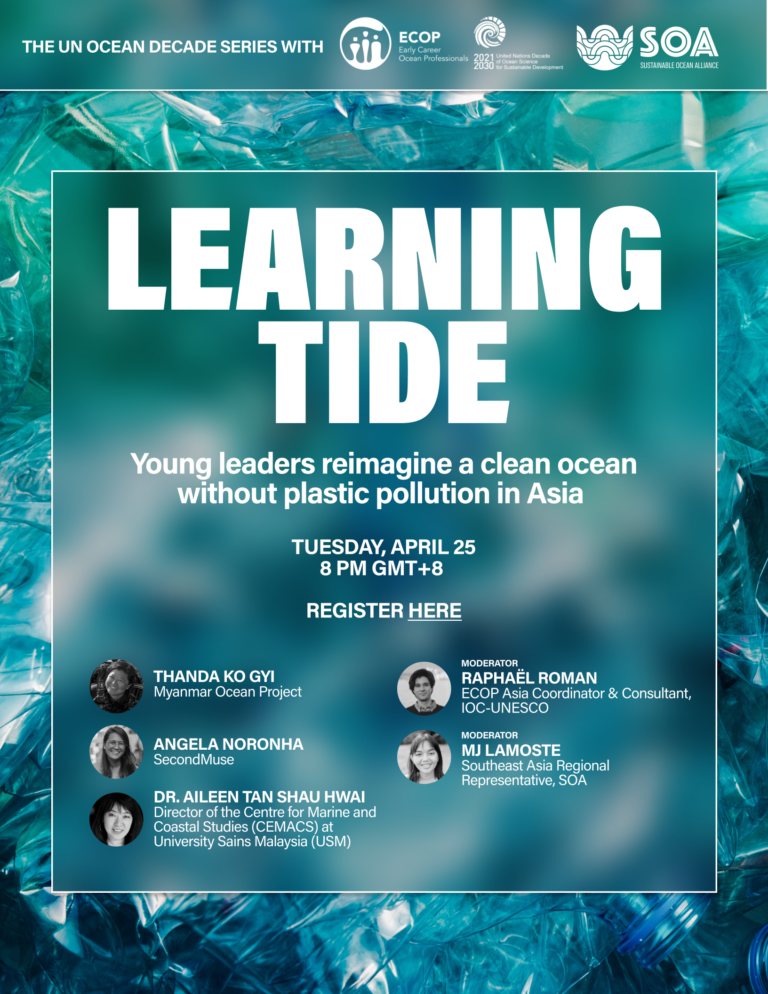
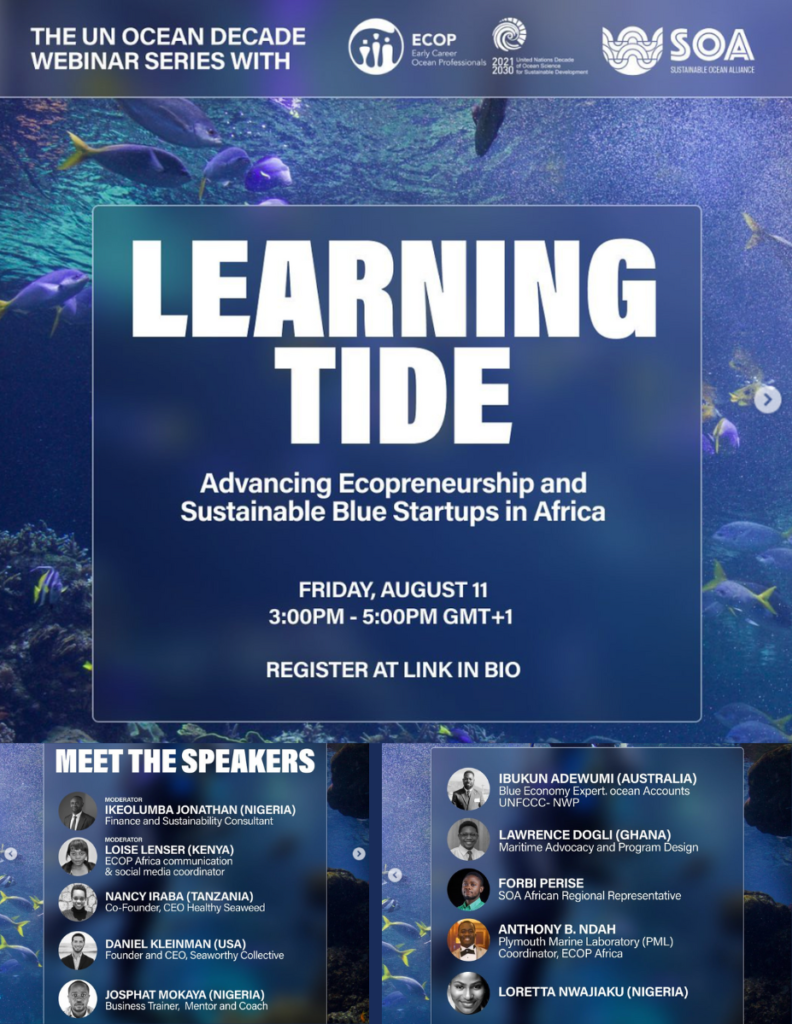
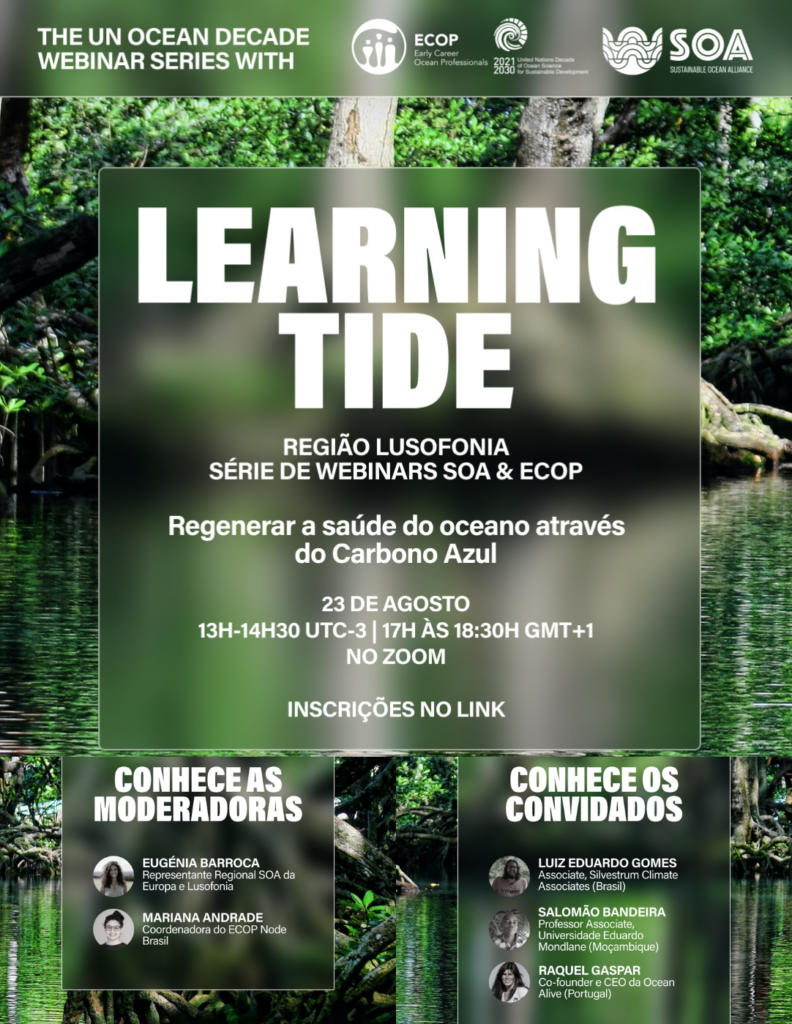
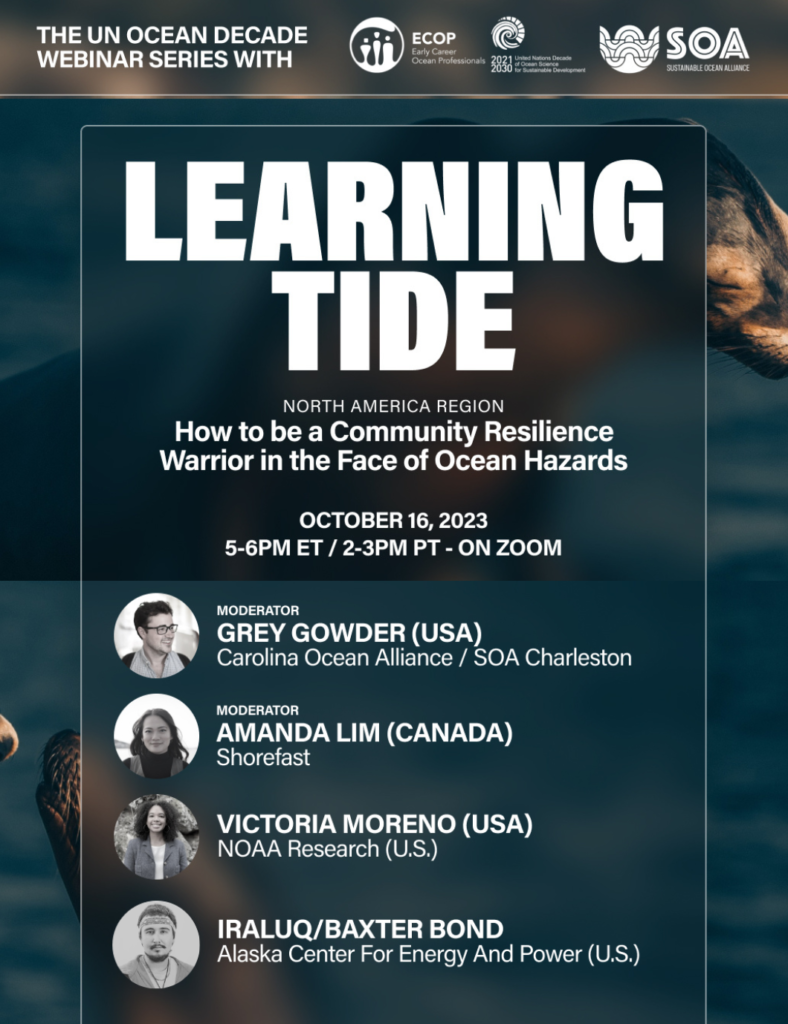
Watch the Learning Tide series: a joint webinar series with Sustainable Ocean Alliance and the ECOP Programme for the UN Ocean Decade
Click the poster to watch the recording over on our YouTube channel.